Investor information

Cabin Investment FAQs

Find clear answers to common questions about owning a Managed Rental Cabin.

Topics include ownership, pooled income, expenses, management fees, GST, insurance, maintenance, monthly payments, investment risks and the options available when you decide to sell or remove a cabin.

Ownership

What exactly do I own?
You own the physical investment cabin identified in your purchase documentation and Cabin Management Agreement. The cabin is classifed as a commercial chattel and is a registered and warranted vehicle with the NZTA.
Entering the Cabin Management Agreement gives the Manager exclusive possession of the cabin for management purposes, but it does not transfer ownership of the cabin to the Manager.
How is my ownership recorded?
Your investment cabins are recorded on the front page of the Cabin Management Agreement or in the attached Investment Cabins Schedule.
Your cabin purchase documentation with Cabins To Go Limited should also identify the cabin or cabins you have purchased. The agreement allows you to register your security interest in the cabins on the Personal Property Securities Register. The Manager will provide the information required to complete the registration.
Can my cabin be separately identified?
Yes. Each investment cabin should have an individual identifier recorded in the Cabin Management Agreement or Investment Cabins Schedule.
This allows your cabin to be distinguished from the other investor-owned cabins in the managed pool.
You are able to choose this name for the cabin.
Where will my cabin be located?
Your cabin will not necessarily remain at one permanent location. Depending on its rental status, it may be:
  • At a third-party hirer’s property.
  • Being delivered to or collected from a hirer.
  • Stored by the Manager between hires.
  • At the Manager’s premises for inspection, maintenance or repair.
The Manager manages the placement and movement of cabins as part of the management services.
Can I inspect my cabin?
You cannot access or visit your cabin without prior written approval from the Manager. Owners must also not contact cabin hirers or visit a cabin at a hirer’s property without approval.
This falls under the Privacy Act 2020.
The Manager endeavours to inspect and record the condition of each cabin after it is returned by a hirer. An owner who wishes to inspect a cabin could be provided with this documentation.

Returns

How is the annualised ROI calculated?
The Cabin Management Agreement defines the Return on Investment Percentage as the owner’s monthly share of income, annualised and compared with the original cost of the investment cabins including GST.
In simplified form:
Monthly Income × 12 ÷ original cabin purchase cost ×100
The calculation is based on the owner’s net proportionate Monthly Income after the relevant managed pool and individual cabin expenses have been deducted.
Are returns guaranteed?
No. Rental income, occupancy, monthly payouts and annualised returns are not guaranteed.
Historic performance and calculator results are provided to help investors understand how the managed pool has previously performed. They should not be treated as a promise or forecast of future results.
Why do monthly payouts change?
Monthly payouts can change because of factors including:
  • The number of cabins on hire.
  • The rental revenue invoiced during the month.
  • The number of days in the month.
  • The timing of cabin hire payments.
  • Cleaning, repairs and maintenance.
  • Tyre replacement.
  • Insurance costs.
  • Hirer defaults or unpaid rent.
  • Amounts recovered from hirers.
  • Expenses relating specifically to an owner’s cabin.
The agreement’s notional monthly income calculation can also be affected by the number of Friday hire-fee days compared with Monday hire-fee days during a particular month.
Are the displayed returns before or after expenses?
The calculator and historic returns are presented using Monthly Income after management fees, operating expenses, other managed pool costs and relevant individual cabin expenses have been deducted.
Operating expenses and other pool costs are therefore already reflected in the displayed return.
The figures are before an investor’s personal or business income tax obligations. GST treatment will depend on the investor’s circumstances.
How does pooled income work?
Rental revenue generated by cabins in the managed pool is combined. Many of the expenses involved in operating those cabins are also combined.
Each owner receives a proportionate share of the resulting monthly income using the calculation contained in the Cabin Management Agreement.
Pooling helps spread rental revenue and common operating costs across the wider pool rather than treating each cabin as a completely separate rental business.  This allows for a smoother income return each month and allows an investor to earn revenue even when the cabin is between hires.
What happens when my cabin is between hires?
The Manager stores and manages cabins when they are not hired.
Because revenue is pooled, an individual cabin being temporarily between hires still generates an income for the owner. The owner continues to participate in the overall results of the managed pool.

Costs

What management fee is charged?
The current Cabin Management Agreement records a management fee of:
21.739% of Managed Pool Revenue, excluding GST (25% including GST).
The applicable fee should always be checked in the final Cabin Management Agreement provided to the investor before purchase.
What expenses are paid from the managed pool?
Managed Pool Expenses can include:
  • Cabin cleaning and inspections.
  • Repairs and maintenance.
  • Parts and labour supplied by staff or subcontractors.
  • PPSR charges.
  • Hirer credit checks.
  • Merchant Fees.
Other expenses that relate specifically to an individual owner’s cabin, such as insurance, are treated as Individualised Expenses.
Who pays for repairs and maintenance?
The Manager may arrange the repair, maintenance and compliance work it reasonably considers necessary.
Costs that relate generally to operating the rental pool may be treated as Managed Pool Expenses.
Where damage has been caused by a hirer, the hirer’s bond may be used, and reasonable steps may be taken to recover any additional amount owed.
Who pays for transport and relocation?
The Manager manages the routine delivery of cabins to hirers and their collection after a hire ends. The agreement allows the Manager to charge hirers directly for services such as cabin delivery and collection.
Is the cabin insured?
The cabin owner must maintain cabin insurance through the approved insurer identified in the Cabin Management Agreement.
This cover must be linked with the public liability and cabin transport insurance maintained by the Manager. Insurance costs relating to an individual cabin are treated as an Individualised Expense.
A monthly premium payment is deducted using a Finance Company.  Owners have the option of paying for insurance directly on an annual basis to avoid interest and admin fees.
Details of the current policies, exclusions, excesses and levels of cover should be reviewed before investing.
What happens if a hirer damages my cabin?
The Manager collects a bond from the hirer and holds it in a trust account.
After the cabin is returned, the Manager assesses the cabin for damage and the account for unpaid rent. The bond may be applied towards those costs, with any remaining balance returned to the hirer.
The Manager will also endeavour to recover any amount owed above the value of the bond.

Tax and GST

Is GST added to the cabin purchase price?
The purchase quotation and sale agreement supplied by Cabins To Go Limited does include  GST. A GST-registered investor may be able to claim GST to the extent that the cabin is used in a taxable activity.
Do investors need to be GST registered?
Purchasing an investment cabin does not require registration for GST.
Inland Revenue currently requires GST registration where an entity carries on a taxable activity and its taxable turnover reaches or is expected to reach $60,000 in a 12-month period, or where it adds GST to its prices. Voluntary registration may also be possible in some circumstances.
The correct treatment may depend on the investor’s other business activities, ownership structure and expected income. Independent accounting advice should be obtained before purchase.
Can depreciation be claimed for business investors?
A business may generally claim depreciation on qualifying capital assets it owns and uses, or intends to use, in its business.
The appropriate treatment and depreciation rate for a portable rental cabin will depend on how the asset is classified and used. Investors should ask their accountant to confirm the applicable rate and method.
Could the cabin qualify for Investment Boost for Business investors?
The purchase of a new rental cabin may qualify for Investment Boost if the cabin meets Inland Revenue’s eligibility requirements.
Investment Boost currently allows an eligible business to deduct 20% of the cost of a qualifying new or new-to-New-Zealand asset. Depreciation is then calculated on the remaining 80% of the asset’s cost. The asset must be depreciable and first available for business use on or after 22 May 2025.
Eligibility will depend on the cabin's tax classification, ownership and business use. Investors should obtain independent tax advice.
What records are supplied for my accountant?
Under the Cabin Management Agreement, owners receive a monthly tax statement that can include:
  • Share of rental revenue.
  • Penalty income.
  • Other recovered income.
  • Management fees.
  • Repairs and maintenance.
  • PPSR charges.
  • Individual cabin expenses.
  • GST.
The Manager also arranges an annual independent audit of the managed pool’s financial statements and makes the auditor’s report available to owners.
The purchase invoice  should be retained for GST, depreciation and Investment Boost purposes.

Risk and Exit

What are the principal risks?
The principal risks include:
  • Occupancy or rental demand falling.
  • Rental revenue being lower than expected.
  • Hirers failing to pay amounts owed.
  • Hirers breaching their hire agreements.
  • Damage to an investment cabin.
  • Repair, maintenance or insurance costs increasing.
  • Monthly Income being deferred if the trust account has insufficient funds.
  • A cabin becoming unsuitable or uneconomic to retain in the pool.
  • The eventual resale value being lower than the original purchase price.
The manager is very diligent in ensuring each of these risks are managed with daily bank reconciliations and hirer account reviews. Insurance is also a vital component in the investment model.
What happens if occupancy falls?
Lower occupancy would generally reduce Managed Pool Revenue and may reduce the Monthly Income distributed to owners.
Pooling spreads this effect across the pool, but it does not eliminate it. An owner’s return depends on the overall revenue and expenses of the managed pool.
The manager incurs significant cost in online advertising and operates a close review of results to ensure occupancy reaches the KPI of 95%.
What happens if operating costs rise?
Higher managed pool or individual cabin expenses reduce the amount available for distribution as Monthly Income.
This could include increases in cleaning, repairs, maintenance, labour, parts, tyres, insurance, warrants or compliance expenses.
The Manager may arrange repairs, maintenance and compliance work it reasonably considers necessary. The rates for goods and services supplied by the Manager or third parties may change over time.
The manager works to ensure the best priced contractor is employed and looks at rental income rates to offset any ongoing cost increases.
What happens if the manager changes?
The current Cabin Management Agreement is between the owner and the Manager. This agreement is assignable to a new manager if the business is on sold.
Can I sell my cabin?
Yes, subject to the sale and transfer procedures contained in the Cabin Management Agreement.
An owner wishing to sell can first offer the cabin to the other managed pool owners through a Managed Pool Transfer Notice. If it is not purchased by another owner, it can then be offered to the Manager through a Manager Transfer Notice.
A cabin may also be sold to a third party. , The third-party purchaser must first enter into a Cabin Management Agreement with the Manager to continue management of the cabin in the pool.
The first cabin purchased is also available to take for personal use at the end of a current hire period.
Is there a guaranteed buy-back?
No. The Cabin Management Agreement does not provide a guaranteed buy-back.
A Manager Transfer Notice is an offer to sell the cabin to the Manager. The Manager may choose whether to accept that offer.
The agreement also requires the proposed sale price in a Managed Pool Transfer Notice or Manager Transfer Notice to represent the cabin’s reasonable market value.
What is the expected working life of a cabin?
The cabin is built like a house and therefore is expected to have a similar life expectancy.
Any appliances in the cabin have a supplier's warranty and any contractors work is covered by a back at base warranty.
Any wear and tear in the cabin is included in the maintenance pool cost.

Getting Started

Can I purchase through a company or trust?
The Cabin Management Agreement can be completed by an individual, a company, trust structure or other legal entity.
Investors considering a business entity should obtain accounting and legal advice.
Can I purchase more than one cabin?
Yes. The Cabin Management Agreement can cover multiple investment cabins.
If an existing owner later purchases additional cabins that the Manager accepts into the managed pool, the existing agreement will  implicitly apply to those additional cabins also.
Can I visit the manufacturing facility?
Yes. Prospective investors are welcome to visit Cabins To Go’s factory to view the cabin construction process, completed cabins and the features included in the investment specification. Any visit should be arranged in advance.
During production Cabins to go Limited will send through update photos too.
What information is contained in the Information Memorandum?
The Information Memorandum provides prospective investors with more detailed information about the current opportunity, including:
  • The investment structure.
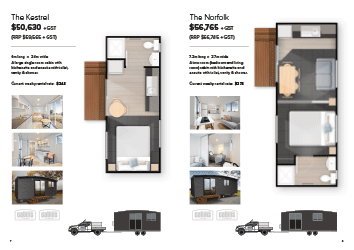
  • Available cabin models.
  • Current cabin pricing.
  • The regional managed pool.
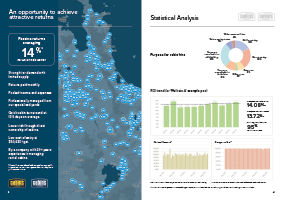
  • Historic occupancy and returns.
  • How Monthly Income is calculated.
  • Management fees and expenses.
  • Insurance.
  • Tax and GST considerations.
  • Principal risks.
  • Sale and removal options.
  • The purchase and management process.
The Information Memorandum should be read alongside the cabin purchase documents and Cabin Management Agreement.
What is the next step after registering interest?
After registering your interest, a member of the Cabins To Go Limited team will contact you to discuss the opportunity and answer your initial questions.
The next steps will generally include:
  • Receiving and reviewing the current Information Memorandum.
  • Discussing cabin availability, pricing and expected timeframes.
  • Reviewing the cabin purchase documents and Cabin Management Agreement.
  • Obtaining any financial, legal, accounting or tax advice you require.
  • Confirming the purchasing entity and GST status.
  • Selecting the cabin model and number of cabins.
  • Signing the relevant documents and completing the agreed payment process:
  • Paying 10% Deposit to commit to Production.
  • Paying 90% balance on completion of production
Registering an interest does not commit you to purchasing a cabin.
Disclaimer
These FAQs provide a general summary only. They do not replace the Cabin Management Agreement, Cabin Purchase Agreement, Information Memorandum, or independent professional advice. If there is any difference between this website and the signed investment documents, the signed documents will apply. Returns, occupancy and resale values are not guaranteed, and past performance is not a guarantee of future results.
Further information is provided in the Information Memorandum
Waikato Cabins Investment Opportunity Information Memorandum
Register Your Interest
To receive an Information Memorandum enter your details in our simple form below or contact Kim Reeves directly.
Kim Reeves - Cabin Sales
Kim Reeves Cabin Sales Manager
* Calculator results and historic returns are provided for illustration. Past performance is not a guarantee of future returns. Prospective investors should read the Information Memorandum and obtain independent financial, legal and tax advice before making an investment decision. Average annualised return based on the current BOP Pool for the period March 2025 to date. Some photos show furniture and appliances which are not included.

©   Cabins To Go Ltd. Website by pixelmagic